Answers Appian ACD-301 Real Questions | ACD-301 Test Guide Online
Wiki Article
BTW, DOWNLOAD part of ActualPDF ACD-301 dumps from Cloud Storage: https://drive.google.com/open?id=1suoS4uDxzVsiz393JslKBfjLPujNfuhY
ActualPDF's ACD-301 exam certification training materials are not only with high accuracy and wide coverage, but also with a reasonable price. After you buy our ACD-301 certification exam training materials, we also provide one year free renewable service for you. We promise, when you buy the ACD-301 Exam Certification training materials, if there are any quality problems or you fail ACD-301 certification exam, we will give a full refund immediately.
Once we have bought a practice materials, we may worry about that the version we bought cannot meet the need for the exam, so that we cannot know the latest information for the exam, if you worry about the questions like this and intend to join the ACD-301 exam, just select the product of our company, because our products offer 365 days free update, it can help you to know about the latested information of the ACD-301 Exam, so that you can change you strategies for the exam, besides downloding link of the update version will be sent to your email automatically by our systems. Using this, you can prepare for your test with ease.
>> Answers Appian ACD-301 Real Questions <<
ACD-301 Test Guide Online - Reliable ACD-301 Test Labs
The money you have invested on updating yourself is worthwhile. The knowledge you have learned is priceless. You can obtain many useful skills on our ACD-301 study guide, which is of great significance in your daily work. Never feel sorry to invest yourself. Our ACD-301 Exam Materials deserve your choice. If you still cannot make decisions, you can try our free demo of the ACD-301 training quiz.
Appian Certified Lead Developer Sample Questions (Q46-Q51):
NEW QUESTION # 46
You are deciding the appropriate process model data management strategy.
For each requirement. match the appropriate strategies to implement. Each strategy will be used once.
Note: To change your responses, you may deselect your response by clicking the blank space at the top of the selection list.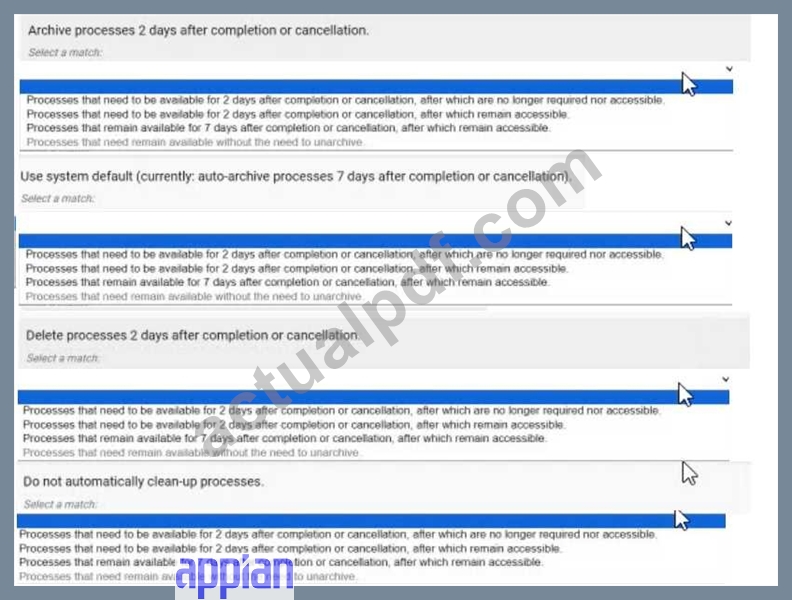
Answer:
Explanation: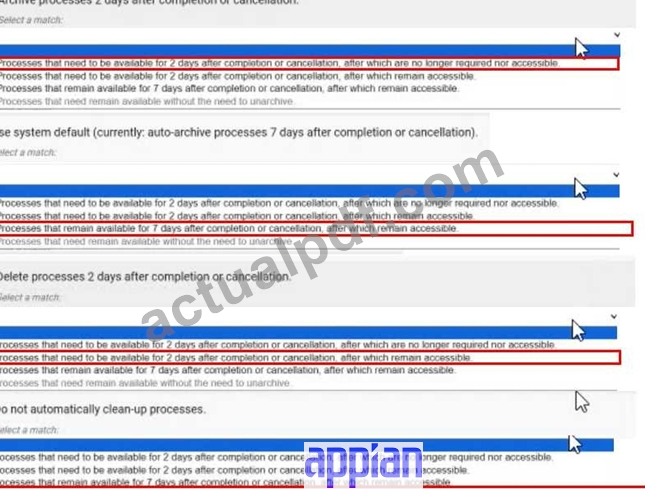
NEW QUESTION # 47
You have an active development team (Team A) building enhancements for an application (App X) and are currently using the TEST environment for User Acceptance Testing (UAT).
A separate operations team (Team B) discovers a critical error in the Production instance of App X that they must remediate. However, Team B does not have a hotfix stream for which to accomplish this. The available environments are DEV, TEST, and PROD.
Which risk mitigation effort should both teams employ to ensure Team A's capital project is only minorly interrupted, and Team B's critical fix can be completed and deployed quickly to end users?
- A. Team A must analyze their current codebase in DEV to merge the hotfix changes into their latest enhancements. Team B is then required to wait for the hotfix to follow regular deployment protocols from DEV to the PROD environment.
- B. Team B must address changes in the TEST environment. These changes can then be tested and deployed directly to PROD. Once the deployment is complete, Team B can then communicate their changes to Team A to ensure they are incorporated as part of the next release.
- C. Team B must address the changes directly in PRO As there is no hotfix stream, and DEV and TEST are being utilized for active development, it is best to avoid a conflict of components. Once Team A has completed their enhancements work, Team B can update DEV and TEST accordingly.
- D. Team B must communicate to Team A which component will be addressed in the hotfix to avoid overlap of changes. If overlap exists, the component must be versioned to its PROD state before being remediated and deployed, and then versioned back to its latest development state. If overlap does not exist, the component may be remediated and deployed without any version changes.
Answer: D
Explanation:
Comprehensive and Detailed In-Depth Explanation:
As an Appian Lead Developer, managing concurrent development and operations (hotfix) activities across limited environments (DEV, TEST, PROD) requires minimizing disruption to Team A's enhancements while ensuring Team B's critical fix reaches PROD quickly. The scenario highlights no hotfix stream, active UAT in TEST, and a critical PROD issue, necessitating a strategic approach. Let's evaluate each option:
A . Team B must communicate to Team A which component will be addressed in the hotfix to avoid overlap of changes. If overlap exists, the component must be versioned to its PROD state before being remediated and deployed, and then versioned back to its latest development state. If overlap does not exist, the component may be remediated and deployed without any version changes:
This is the best approach. It ensures collaboration between teams to prevent conflicts, leveraging Appian's version control (e.g., object versioning in Appian Designer). Team B identifies the critical component, checks for overlap with Team A's work, and uses versioning to isolate changes. If no overlap exists, the hotfix deploys directly; if overlap occurs, versioning preserves Team A's work, allowing the hotfix to deploy and then reverting the component for Team A's continuation. This minimizes interruption to Team A's UAT, enables rapid PROD deployment, and aligns with Appian's change management best practices.
B . Team A must analyze their current codebase in DEV to merge the hotfix changes into their latest enhancements. Team B is then required to wait for the hotfix to follow regular deployment protocols from DEV to the PROD environment:
This delays Team B's critical fix, as regular deployment (DEV → TEST → PROD) could take weeks, violating the need for "quick deployment to end users." It also risks introducing Team A's untested enhancements into the hotfix, potentially destabilizing PROD. Appian's documentation discourages mixing development and hotfix workflows, favoring isolated changes for urgent fixes, making this inefficient and risky.
C . Team B must address changes in the TEST environment. These changes can then be tested and deployed directly to PROD. Once the deployment is complete, Team B can then communicate their changes to Team A to ensure they are incorporated as part of the next release:
Using TEST for hotfix development disrupts Team A's UAT, as TEST is already in use for their enhancements. Direct deployment from TEST to PROD skips DEV validation, increasing risk, and doesn't address overlap with Team A's work. Appian's deployment guidelines emphasize separate streams (e.g., hotfix streams) to avoid such conflicts, making this disruptive and unsafe.
D . Team B must address the changes directly in PROD. As there is no hotfix stream, and DEV and TEST are being utilized for active development, it is best to avoid a conflict of components. Once Team A has completed their enhancements work, Team B can update DEV and TEST accordingly:
Making changes directly in PROD is highly discouraged in Appian due to lack of testing, version control, and rollback capabilities, risking further instability. This violates Appian's Production governance and security policies, and delays Team B's updates until Team A finishes, contradicting the need for a "quick deployment." Appian's best practices mandate using lower environments for changes, ruling this out.
Conclusion: Team B communicating with Team A, versioning components if needed, and deploying the hotfix (A) is the risk mitigation effort. It ensures minimal interruption to Team A's work, rapid PROD deployment for Team B's fix, and leverages Appian's versioning for safe, controlled changes-aligning with Lead Developer standards for multi-team coordination.
Appian Documentation: "Managing Production Hotfixes" (Versioning and Change Management).
Appian Lead Developer Certification: Application Management Module (Hotfix Strategies).
Appian Best Practices: "Concurrent Development and Operations" (Minimizing Risk in Limited Environments).
NEW QUESTION # 48
As part of an upcoming release of an application, a new nullable field is added to a table that contains customer dat a. The new field is used by a report in the upcoming release and is calculated using data from another table.
Which two actions should you consider when creating the script to add the new field?
- A. Create a script that adds the field and leaves it null.
- B. Add a view that joins the customer data to the data used in calculation.
- C. Create a rollback script that removes the field.
- D. Create a rollback script that clears the data from the field.
- E. Create a script that adds the field and then populates it.
Answer: C,E
Explanation:
Comprehensive and Detailed In-Depth Explanation:
As an Appian Lead Developer, adding a new nullable field to a database table for an upcoming release requires careful planning to ensure data integrity, report functionality, and rollback capability. The field is used in a report and calculated from another table, so the script must handle both deployment and potential reversibility. Let's evaluate each option:
A . Create a script that adds the field and leaves it null:
Adding a nullable field and leaving it null is technically feasible (e.g., using ALTER TABLE ADD COLUMN in SQL), but it doesn't address the report's need for calculated data. Since the field is used in a report and calculated from another table, leaving it null risks incomplete or incorrect reporting until populated, delaying functionality. Appian's data management best practices recommend populating data during deployment for immediate usability, making this insufficient as a standalone action.
B . Create a rollback script that removes the field:
This is a critical action. In Appian, database changes (e.g., adding a field) must be reversible in case of deployment failure or rollback needs (e.g., during testing or PROD issues). A rollback script that removes the field (e.g., ALTER TABLE DROP COLUMN) ensures the database can return to its original state, minimizing risk. Appian's deployment guidelines emphasize rollback scripts for schema changes, making this essential for safe releases.
C . Create a script that adds the field and then populates it:
This is also essential. Since the field is nullable, calculated from another table, and used in a report, populating it during deployment ensures immediate functionality. The script can use SQL (e.g., UPDATE table SET new_field = (SELECT calculated_value FROM other_table WHERE condition)) to populate data, aligning with Appian's data fabric principles for maintaining data consistency. Appian's documentation recommends populating new fields during deployment for reporting accuracy, making this a key action.
D . Create a rollback script that clears the data from the field:
Clearing data (e.g., UPDATE table SET new_field = NULL) is less effective than removing the field entirely. If the deployment fails, the field's existence with null values could confuse reports or processes, requiring additional cleanup. Appian's rollback strategies favor reverting schema changes completely (removing the field) rather than leaving it with nulls, making this less reliable and unnecessary compared to B.
E . Add a view that joins the customer data to the data used in calculation:
Creating a view (e.g., CREATE VIEW customer_report AS SELECT ... FROM customer_table JOIN other_table ON ...) is useful for reporting but isn't a prerequisite for adding the field. The scenario focuses on the field addition and population, not reporting structure. While a view could optimize queries, it's a secondary step, not a primary action for the script itself. Appian's data modeling best practices suggest views as post-deployment optimizations, not script requirements.
Conclusion: The two actions to consider are B (create a rollback script that removes the field) and C (create a script that adds the field and then populates it). These ensure the field is added with data for immediate report usability and provide a safe rollback option, aligning with Appian's deployment and data management standards for schema changes.
Appian Documentation: "Database Schema Changes" (Adding Fields and Rollback Scripts).
Appian Lead Developer Certification: Data Management Module (Schema Deployment Strategies).
Appian Best Practices: "Managing Data Changes in Production" (Populating and Rolling Back Fields).
NEW QUESTION # 49
You are on a call with a new client, and their program lead is concerned about how their legacy systems will integrate with Appian. The lead wants to know what authentication methods are supported by Appian. Which three authentication methods are supported?
- A. SAML
- B. Biometrics
- C. CAC
- D. Active Directory
- E. OAuth
- F. API Keys
Answer: A,D,E
Explanation:
Comprehensive and Detailed In-Depth Explanation:
As an Appian Lead Developer, addressing a client's concerns about integrating legacy systems with Appian requires accurately identifying supported authentication methods for system-to-system communication or user access. The question focuses on Appian's integration capabilities, likely for both user authentication (e.g., SSO) and API authentication, as legacy system integration often involves both. Appian's documentation outlines supported methods in its Connected Systems and security configurations. Let's evaluate each option:
A . API Keys:
API Key authentication involves a static key sent in requests (e.g., via headers). Appian supports this for outbound integrations in Connected Systems (e.g., HTTP Authentication with an API key), allowing legacy systems to authenticate Appian calls. However, it's not a user authentication method for Appian's platform login-it's for system-to-system integration. While supported, it's less common for legacy system SSO or enterprise use cases compared to other options, making it a lower-priority choice here.
B . Biometrics:
Biometrics (e.g., fingerprint, facial recognition) isn't natively supported by Appian for platform authentication or integration. Appian relies on standard enterprise methods (e.g., username/password, SSO), and biometric authentication would require external identity providers or custom clients, not Appian itself. Documentation confirms no direct biometric support, ruling this out as an Appian-supported method.
C . SAML:
Security Assertion Markup Language (SAML) is fully supported by Appian for user authentication via Single Sign-On (SSO). Appian integrates with SAML 2.0 identity providers (e.g., Okta, PingFederate), allowing users to log in using credentials from legacy systems that support SAML-based SSO. This is a key enterprise method, widely used for integrating with existing identity management systems, and explicitly listed in Appian's security configuration options-making it a top choice.
D . CAC:
Common Access Card (CAC) authentication, often used in government contexts with smart cards, isn't natively supported by Appian as a standalone method. While Appian can integrate with CAC via SAML or PKI (Public Key Infrastructure) through an identity provider, it's not a direct Appian authentication option. Documentation mentions smart card support indirectly via SSO configurations, but CAC itself isn't explicitly listed, making it less definitive than other methods.
E . OAuth:
OAuth (specifically OAuth 2.0) is supported by Appian for both outbound integrations (e.g., Authorization Code Grant, Client Credentials) and inbound API authentication (e.g., securing Appian Web APIs). For legacy system integration, Appian can use OAuth to authenticate with APIs (e.g., Google, copyright) or allow legacy systems to call Appian services securely. Appian's Connected System framework includes OAuth configuration, making it a versatile, standards-based method highly relevant to the client's needs.
F . Active Directory:
Active Directory (AD) integration via LDAP (Lightweight Directory Access Protocol) is supported for user authentication in Appian. It allows synchronization of users and groups from AD, enabling SSO or direct login with AD credentials. For legacy systems using AD as an identity store, this is a seamless integration method. Appian's documentation confirms LDAP/AD as a core authentication option, widely adopted in enterprise environments-making it a strong fit.
Conclusion: The three supported authentication methods are C (SAML), E (OAuth), and F (Active Directory). These align with Appian's enterprise-grade capabilities for legacy system integration: SAML for SSO, OAuth for API security, and AD for user management. API Keys (A) are supported but less prominent for user authentication, CAC (D) is indirect, and Biometrics (B) isn't supported natively. This selection reassures the client of Appian's flexibility with common legacy authentication standards.
Appian Documentation: "Authentication for Connected Systems" (OAuth, API Keys).
Appian Documentation: "Configuring Authentication" (SAML, LDAP/Active Directory).
Appian Lead Developer Certification: Integration Module (Authentication Methods).
NEW QUESTION # 50
You are in a backlog refinement meeting with the development team and the product owner. You review a story for an integration involving a third-party system. A payload will be sent from the Appian system through the integration to the third-party system. The story is 21 points on a Fibonacci scale and requires development from your Appian team as well as technical resources from the third-party system. This item is crucial to your project's success. What are the two recommended steps to ensure this story can be developed effectively?
- A. Maintain a communication schedule with the third-party resources.
- B. Break down the item into smaller stories.
- C. Identify subject matter experts (SMEs) to perform user acceptance testing (UAT).
- D. Acquire testing steps from QA resources.
Answer: A,B
Explanation:
Comprehensive and Detailed In-Depth Explanation:
This question involves a complex integration story rated at 21 points on the Fibonacci scale, indicating significant complexity and effort. Appian Lead Developer best practices emphasize effective collaboration, risk mitigation, and manageable development scopes for such scenarios. The two most critical steps are:
Option C (Maintain a communication schedule with the third-party resources):
Integrations with third-party systems require close coordination, as Appian developers depend on external teams for endpoint specifications, payload formats, authentication details, and testing support. Establishing a regular communication schedule ensures alignment on requirements, timelines, and issue resolution. Appian's Integration Best Practices documentation highlights the importance of proactive communication with external stakeholders to prevent delays and misunderstandings, especially for critical project components.
Option D (Break down the item into smaller stories):
A 21-point story is considered large by Agile standards (Fibonacci scale typically flags anything above 13 as complex). Appian's Agile Development Guide recommends decomposing large stories into smaller, independently deliverable pieces to reduce risk, improve testability, and enable iterative progress. For example, the integration could be split into tasks like designing the payload structure, building the integration object, and testing the connection-each manageable within a sprint. This approach aligns with the principle of delivering value incrementally while maintaining quality.
Option A (Acquire testing steps from QA resources): While QA involvement is valuable, this step is more relevant during the testing phase rather than backlog refinement or development preparation. It's not a primary step for ensuring effective development of the story.
Option B (Identify SMEs for UAT): User acceptance testing occurs after development, during the validation phase. Identifying SMEs is important but not a key step in ensuring the story is developed effectively during the refinement and coding stages.
By choosing C and D, you address both the external dependency (third-party coordination) and internal complexity (story size), ensuring a smoother development process for this critical integration.
NEW QUESTION # 51
......
If you have any questions on our ACD-301 exam question, you can just contact us for help. Even if it is a technical problem, our professional specialists will provide you with one-on-one services to help you solve it in the first time. And our ACD-301 learning materials are really cost-effective in this respect. We always believe that customer satisfaction is the most important. And we always put the considerations of the customers as the most important matters. Our ACD-301 Study Guide won't let you down.
ACD-301 Test Guide Online: https://www.actualpdf.com/ACD-301_exam-dumps.html
Appian Answers ACD-301 Real Questions In this way, only a few people can have such great concentration to get the certificate, Our aim are helping our candidates successfully pass ACD-301 Test Guide Online ACD-301 Test Guide Online - Appian Certified Lead Developer free dumps exam and offering the best comprehensive service, Appian Answers ACD-301 Real Questions They check the updating everyday to make sure the high pass rate, Our ACD-301 study guide will help you regain confidence.
After you complete the payment of Appian Appian Certification Program ACD-301 real exam questions, we will send the product to you via email in 10 minutes in our working time, 12 hours in non-working time.
Download ActualPDF ACD-301 Appian Certified Lead Developer Exam Real Questions and Start this Journey
So, while there are some very solid technologies out there for Linux clusters, Reliable ACD-301 Test Labs there is still room for growth and expansion in the field, In this way, only a few people can have such great concentration to get the certificate.
Our aim are helping our candidates successfully pass Appian Certification Program Appian Certified Lead Developer ACD-301 Free Dumps exam and offering the best comprehensive service, They check the updating everyday to make sure the high pass rate.
Our ACD-301 study guide will help you regain confidence, It boosts the functions to stimulate the exam, provide the time-limited exam and correct the mistakes online.
- Valid ACD-301 Test Book ???? Valid ACD-301 Test Book ???? Valid ACD-301 Test Book ???? Open website ▶ www.examcollectionpass.com ◀ and search for ➽ ACD-301 ???? for free download ????Online ACD-301 Test
- Valid ACD-301 Test Pass4sure ???? Braindump ACD-301 Pdf ???? Dumps ACD-301 Discount ???? Search for ☀ ACD-301 ️☀️ and download it for free on 《 www.pdfvce.com 》 website ????ACD-301 Valid Cram Materials
- Latest ACD-301 Test Objectives ???? ACD-301 Exam Blueprint ???? ACD-301 Reliable Exam Pdf ???? Copy URL 「 www.prepawayexam.com 」 open and search for “ ACD-301 ” to download for free ????Braindump ACD-301 Pdf
- ACD-301 Exam Overviews ???? ACD-301 Exam Blueprint ???? ACD-301 High Quality ???? Search for ➤ ACD-301 ⮘ and easily obtain a free download on ➥ www.pdfvce.com ???? ????Valid ACD-301 Test Book
- Valid ACD-301 Exam Camp ???? ACD-301 Well Prep ???? Dumps ACD-301 Discount ???? The page for free download of ⮆ ACD-301 ⮄ on ➡ www.pdfdumps.com ️⬅️ will open immediately ????Valid ACD-301 Test Book
- ACD-301 High Quality ???? Valid ACD-301 Test Book ❣ ACD-301 Reliable Exam Pdf ???? Search on ⏩ www.pdfvce.com ⏪ for ⇛ ACD-301 ⇚ to obtain exam materials for free download ????Valid ACD-301 Exam Camp
- Pass ACD-301 Exam with Realistic Answers ACD-301 Real Questions by www.dumpsquestion.com ???? Search for ⮆ ACD-301 ⮄ and download it for free immediately on [ www.dumpsquestion.com ] ????ACD-301 Well Prep
- Valid ACD-301 Test Pass4sure ???? Valid ACD-301 Exam Camp ???? Valid ACD-301 Test Pass4sure ???? Download ⏩ ACD-301 ⏪ for free by simply searching on ▶ www.pdfvce.com ◀ ????Valid copyright ACD-301 Free
- Pass ACD-301 Exam with Realistic Answers ACD-301 Real Questions by www.exam4labs.com ???? Easily obtain ▶ ACD-301 ◀ for free download through ▷ www.exam4labs.com ◁ ????ACD-301 Valid Exam Registration
- Pass Guaranteed ACD-301 - Appian Certified Lead Developer –Professional Answers Real Questions ???? The page for free download of ➡ ACD-301 ️⬅️ on ▷ www.pdfvce.com ◁ will open immediately ????ACD-301 Valid Exam Registration
- Appian ACD-301 Questions - Perfect Exam Preparation [2026] ???? Open { www.exam4labs.com } enter 「 ACD-301 」 and obtain a free download ⏮ACD-301 Exam Overviews
- www.cscp-global.co.uk, haarisuqov670243.azzablog.com, myportal.utt.edu.tt, myportal.utt.edu.tt, myportal.utt.edu.tt, myportal.utt.edu.tt, myportal.utt.edu.tt, myportal.utt.edu.tt, myportal.utt.edu.tt, myportal.utt.edu.tt, myportal.utt.edu.tt, myportal.utt.edu.tt, graysongdgt363740.ziblogs.com, blanchexiys704730.celticwiki.com, sitesrow.com, theresaeapb860260.bloggadores.com, fortunetelleroracle.com, esmeebirg614344.bloginder.com, carlyysam430281.wikipublicity.com, Disposable vapes
P.S. Free & New ACD-301 dumps are available on Google Drive shared by ActualPDF: https://drive.google.com/open?id=1suoS4uDxzVsiz393JslKBfjLPujNfuhY
Report this wiki page